CrowdStrike CTEM: What Falcon Exposure Management Covers and Where the Gaps Are

/can crowdstrike ctem cover my entire security stack?
CrowdStrike CTEM, delivered through Falcon Exposure Management, is strongest for organizations standardized on Falcon, with real-time visibility and adversary-intel-driven prioritization. But most enterprises run findings from many vendors, and CTEM depends on mobilizing fixes across all of them. If your program needs whole-stack coverage, automated ownership, root cause grouping, and fix guidance for every team, a remediation-focused platform like Seemplicity fills the gap.
If you’re searching for CrowdStrike CTEM, you’re probably already running Falcon and wondering whether it can carry your continuous threat exposure management program on its own. It’s a fair question. CrowdStrike has invested heavily in exposure management, and Falcon Exposure Management is now positioned to support every stage of CTEM.
But a CTEM program is only as strong as its coverage and its follow-through. This guide breaks down what CrowdStrike offers, where it works well, where teams tend to hit limits, and what to check before building your program around a single platform.
What CrowdStrike Offers for CTEM
CrowdStrike’s answer to CTEM is Falcon Exposure Management, a module of the Falcon platform that maps its capabilities to each stage of the CTEM cycle.
- Scoping and discovery: Real-time visibility across assets, identities, SaaS apps, and the external attack surface, including native EASM. Asset Criticality AI ties scoping to business impact so crown-jewel assets are flagged early.
- Prioritization: CrowdStrike’s ExPRT.AI model ranks vulnerabilities by their likelihood of exploitation, drawing on the company’s adversary intelligence and real-world attack paths. This is the core of its prioritization story.
- Validation: Falcon Exposure Management assesses whether an attack against a prioritized exposure is actually feasible, supporting the validation stage.
- Mobilization: Falcon Fusion SOAR automates patching, isolation, ticketing, and compensating controls, while Falcon for IT handles intelligent patching.
For organizations that want a managed option, CrowdStrike also offers CTEM as a service through partners such as HCLTech.
Where CrowdStrike CTEM Works Well
Falcon Exposure Management is a strong fit for teams already deep in the CrowdStrike ecosystem.
- Falcon-standardized organizations: If the agent is already deployed across endpoints, servers, and cloud workloads, exposure data starts flowing without new deployment work.
- Endpoint-heavy environments: When most of the attack surface lives on managed devices, Falcon’s telemetry covers a large share of it.
- Threat-intel-driven teams: CrowdStrike’s adversary research feeds directly into prioritization, which is a genuine differentiator.
For these teams, CrowdStrike CTEM can cover a lot of ground with limited operational overhead.
Where Teams Hit Limits
The gaps usually show up once a CTEM program grows beyond what one vendor can see and act on.
Most stacks aren’t single-vendor. Enterprise security teams run SAST, SCA, DAST, cloud security, container scanning, and pen testing tools from many different vendors. A CTEM program needs all of those findings in scope, not just what Falcon detects natively.
Prioritization is strongest on native data. Adversary intelligence is a real advantage, but it delivers the most value when applied to the full exposure picture. Findings from third-party AppSec or cloud tools may not get the same depth of context.
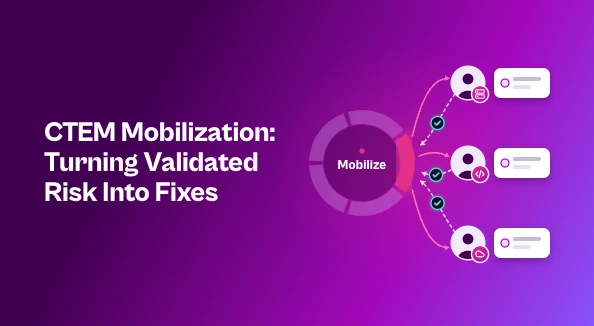
Mobilization is where programs stall. Knowing what to fix is not the same as getting it fixed. Someone still has to work out who owns each exposure, group duplicate work, translate findings into fix instructions, and chase SLAs across teams.
Remediation automation leans toward IT. Patching, isolation, and SOAR playbooks suit IT and endpoint teams. Developers fixing code and cloud engineers fixing misconfigurations need different workflows and different guidance.
Questions to Ask Before Building CTEM Around One Platform
Before committing your CTEM program to CrowdStrike, or any single platform, pressure-test it against these questions:
- Does it ingest findings from every tool in our stack, or mainly its own?
- How is ownership determined, and how are tickets routed to the right team?
- Does it consolidate related findings into fewer fixes, or open one ticket per finding?
- Do fixers get asset-specific remediation guidance, whichever team they sit on?
- Can we report progress and SLA performance across all exposure sources, not just one?
If most answers come back as “only for Falcon data,” you’ll need another layer to run CTEM end to end.
How Seemplicity Fills the Gap
Seemplicity is built for the part of CTEM that single-vendor platforms struggle with: turning exposures from every source into completed fixes.
- Whole-stack coverage: Seemplicity aggregates and normalizes findings from the scanners and security tools across your environment into one backlog, with no blind spots beyond what a single agent can see.
- Mobilization at the core: AI agents take on the manual legwork. Find the Fixer identifies who owns each exposure, root cause grouping consolidates related findings into single fixes (reducing alert volume by up to 90%), and the Remediation Agent embeds step-by-step, asset-specific guidance in every ticket.
- Built for every fixing team: Work flows into Jira, ServiceNow, and the tools developers, cloud engineers, and IT teams already use, with guidance matched to the fix in front of them.
- Full-context prioritization: Reachability and business context are applied across all exposure sources, so teams focus on what attackers can actually reach.
- Program-wide reporting: SLA tracking and reporting span teams, tools, and business units, so you can prove risk reduction for the whole program.
CrowdStrike gives you a strong view of risk inside the Falcon ecosystem. Seemplicity runs CTEM across your entire environment and gets the fixes done.
Run CTEM Across Your Entire Stack
CrowdStrike CTEM is a capable option for Falcon-heavy organizations, particularly for discovery and threat-informed prioritization. But CTEM programs succeed or fail on mobilization, and that takes coverage and remediation workflows that span every tool and every team.
Request a demo to see how Seemplicity turns exposures from across your stack into fixes.
Stay updated on Seemplicity blog
Subscribe today to stay informed and get regular updates from Seemplicity.