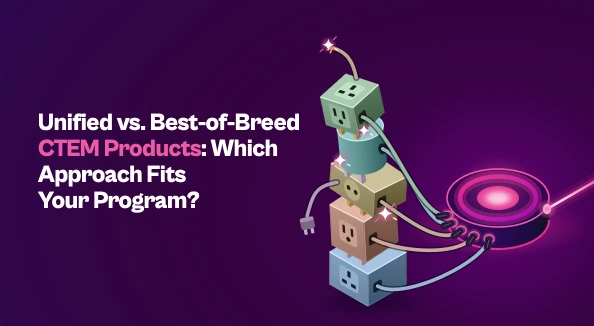
Unified vs. Best-of-Breed CTEM Products: Which Approach Fits Your Program?

/what are the best type of CTEM products?
For most teams, a unified approach works better. Best-of-breed CTEM products go deep in their own areas, but they create fragmented data, duplicate findings, conflicting priorities and lost context between stages, which leads to more findings rather than more fixes. A unified platform brings findings from your existing tools into one data model with consistent prioritization. Ownership and exploitability context then carries all the way through to remediation. The deciding factor isn’t how many vendors you have but whether exposures move smoothly from discovery to closure, and that’s where unification makes the biggest difference.
Continuous threat exposure management is a framework, but plenty of products now support it. Some cover a single stage. Others are built to run the whole cycle from one place. As vendors consolidate and security budgets come under closer scrutiny, more teams are asking the same question: should we bring our CTEM products together on one platform, or assemble the best tool for each job?
Both approaches can work on paper. In practice, they lead to very different day-to-day realities for the people running the program. Here’s how they compare.
What Unified and Best-of-Breed Mean for CTEM Products
A unified approach runs most or all of the CTEM cycle on one platform, with one data model and one view of risk. The cycle covers scoping, discovery, prioritization, validation and mobilization.
A best-of-breed approach picks a specialist for each need. That might mean an external attack surface tool for internet-facing assets, a breach and attack simulation tool for validation, and separate scanners for cloud, code and infrastructure.
Most security teams never consciously chose either. Their stack grew one purchase at a time, and they ended up with best-of-breed by default.
The Case for Best-of-Breed CTEM Products
The appeal is easy to see. Each product goes deep in its own area, so teams can pick what they consider the strongest option for cloud, AppSec or the external attack surface. If one tool underdelivers, it can be swapped out without touching the rest.
The cost shows up between the tools rather than inside them:
- Fragmented data. Each product has its own format, scoring and asset identifiers, so the same vulnerability can appear three times with three different severity ratings.
- Conflicting priorities. Without a shared risk model, what looks urgent depends on which console you happen to be looking at.
- Lost context. Ownership, business criticality and exploitability rarely follow a finding from the tool that found it to the team that has to fix it.
- Integration overhead. Someone has to build and maintain the connections between products, and that someone is usually the security team.
The result is often more findings, not more fixes. Every new specialist adds visibility, and it adds to the backlog too.
The Case for Unified CTEM Products
A unified approach tackles exactly the problems that build up between tools:
- One data model. Findings are normalized and deduplicated once, so asset counts and risk scores mean the same thing everywhere.
- Consistent prioritization. The same logic applies across cloud, code, infrastructure and external exposures, so the riskiest issues rise to the top regardless of where they came from.
- Context that carries through. Business criticality, exploitability and ownership travel with each exposure all the way into remediation.
- Less operational overhead. There are fewer consoles to check, fewer integrations to maintain and one place to report from.
- Clearer measurement. You can track exposure across the whole environment instead of piecing together a picture tool by tool.
The usual concern is depth, since a unified platform might not match a specialist in a niche area. That concern mostly goes away when the platform unifies data from your existing tools rather than replacing them. You keep the specialist coverage and lose the fragmentation.
What Actually Determines Whether Your Stack Works
The number of vendors in your stack matters less than how exposure data moves through the cycle. Whatever you’re running today, these questions will tell you whether it’s working:
- Are findings from every source normalized and deduplicated before they’re prioritized?
- Is one prioritization model applied across all sources?
- Do validation results change priority automatically?
- Do confirmed exposures reach the right owner and get tracked to closure?
Best-of-breed stacks tend to fail at the handoffs, and most visibly at mobilization, where findings have to become fixes. That’s also where a unified approach makes the biggest difference.
How to Decide
Start from where your program stalls. If discovery is strong but the backlog keeps growing, adding another specialist won’t help. The gap is coordination, not coverage.
Count the handoffs. Every tool that doesn’t share data with the next stage is a point where context gets lost and work slows down.
Factor in team capacity. Maintaining integrations, reconciling conflicting scores and creating tickets by hand are all work that doesn’t reduce exposure.
Treat complexity as a reason to unify. Multi-cloud, on-prem, code and the external attack surface each produce findings in their own format. The more varied your environment, the more a single view of risk matters.
Check for openness. A unified platform should work with the tools you already run, not force you to rip them out.
How Seemplicity Fits In
Seemplicity is a unified, agentic exposure management platform built to run the CTEM cycle across the tools you already own.
It pulls findings from 100+ security tools into a single view, with normalization and deduplication across every source. It prioritizes exposures using threat intelligence and business context. Its AI Analysts then validate exploitability by checking network reachability, code reachability and whether existing EDR controls already block the technique.
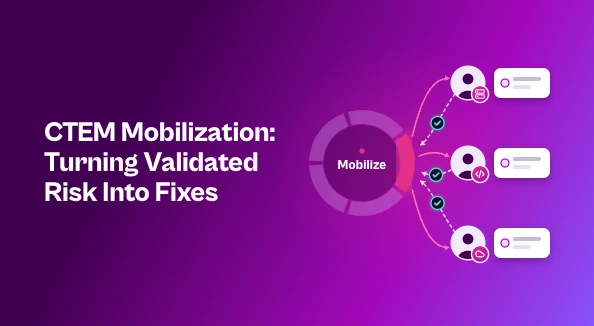
From there, Seemplicity handles mobilization. It maps each exposure to the right owner and routes the work into tools like Jira and ServiceNow. Response Options offers ways to fix or mitigate each exposure, and SLA tracking follows the work through to closure. Reporting shows whether exposure is actually going down.
Teams get one platform and one data model without giving up the scanners they rely on.
Choosing CTEM Products That Get Exposures Fixed
The right CTEM products are the ones that turn findings into fixes, not the ones that add the most logos to your stack. Best-of-breed can deliver depth, but without a unifying layer it also delivers duplicates, conflicting priorities and stalled remediation. A unified approach brings the cycle together so every exposure moves from discovery to closure with its context intact.
Stay updated on Seemplicity blog
Subscribe today to stay informed and get regular updates from Seemplicity.