

/what is CTEM technology?
CTEM technology is the set of tools that supports a continuous threat exposure management program, and it centers on two categories. Exposure Assessment Platforms (EAP) consolidate findings from across your security stack, prioritize them by real risk, and drive remediation. Adversarial Exposure Validation (AEV) emulates real attacks to prove which exposures are exploitable. Each one leaves a gap on its own: an EAP ranks exposures without proof, and AEV produces proof without a path to the fix. The strongest CTEM programs connect the two so that exposures move from analysis to validation to resolution without losing context.
Security teams don’t lack data. Most run a dozen or more scanners, each producing its own stream of findings. The hard part is turning that volume into a short list of exposures that are real, and then getting them fixed.
Continuous threat exposure management (CTEM) gives teams a framework for doing that, across five stages: scoping, discovery, prioritization, validation, and mobilization. Two technology categories now do most of the work in that cycle. Exposure Assessment Platforms (EAP) analyze and prioritize exposures, and Adversarial Exposure Validation (AEV) proves which of them can be exploited.
This post covers what each category does, how they fit together, and where gaps remain.
What Is CTEM Technology?
CTEM technology is the set of tools and platforms that support a CTEM program across its stages. CTEM is still a framework, but it depends on technology at every step, and the market has organized itself around two core categories.
Both categories came from consolidating older ones:
- Exposure Assessment Platforms combine vulnerability assessment (VA) and vulnerability prioritization technology (VPT). Previously, one tool found issues and another ranked them.
- Adversarial Exposure Validation combines breach and attack simulation (BAS) and automated penetration testing. Previously, these were separate ways to test whether an attack would work.
The consolidation reflects how teams actually work. Finding and ranking exposures is one job, and proving they’re exploitable is another.
Exposure Assessment Platforms: The Analysis Layer
Exposure Assessment Platforms sit on top of the tools you already run. They pull findings from vulnerability scanners, cloud security tools, application security testing, and asset inventories into one view.
From there, an EAP does three things:
- Consolidates the data. Deduplication and normalization turn findings from many tools, each with its own format and severity scale, into one consistent record per exposure.
- Prioritizes by real risk. CVSS is one input among several. EAPs weigh exploitability signals such as known exploited vulnerabilities, along with asset criticality and business context.
- Supports remediation. Strong EAPs connect prioritized exposures to the owners and workflows that will fix them.
In CTEM terms, EAPs cover discovery, prioritization, and mobilization.
Adversarial Exposure Validation: The Proof Layer
Adversarial exposure validation answers a narrower question: can an attacker actually use this exposure in our environment?
AEV tools safely emulate real attack techniques to find out. They chain weaknesses together the way an attacker would, test whether existing controls like EDR or firewalls stop known techniques, and produce evidence of what gets through.
AEV covers the validation stage. Its output is proof, not another score, which is what makes it valuable to teams buried in findings that all look urgent.
How EAP and AEV Work Together
On their own, each category leaves a gap. An EAP without validation ranks exposures by likely risk but can’t confirm which ones are exploitable. AEV without an EAP proves exploitability but has no complete view of the exposure landscape, and no path from proof to a fix.
Together, they form a loop:
- The EAP narrows the field. It consolidates findings across the stack and surfaces the exposures most likely to matter.
- AEV tests the shortlist. Validation confirms which of those exposures attackers can reach and exploit.
- Results feed back into prioritization. Proven exposures move up and unreachable ones drop, so the priority list reflects evidence rather than estimates.
- Validated exposures move into remediation. The EAP routes them to the right owners through the workflows those teams already use.
The point of pairing them is better decisions: fewer exposures to chase, more confidence that the ones being fixed matter.
How Seemplicity Fits In
Seemplicity’s Agentic Exposure Action Platform works as the analysis and action layer of the CTEM technology stack. It aggregates and deduplicates findings from your existing scanners and security tools, including AEV results, and prioritizes them using threat intelligence and business context.
It also adds context-based validation. Seemplicity’s AI Analysts investigate each finding in your actual environment, checking runtime configuration, network reachability, whether vulnerable code is reachable, and whether a dependency is used. Every verdict comes with an auditable evidence trail.
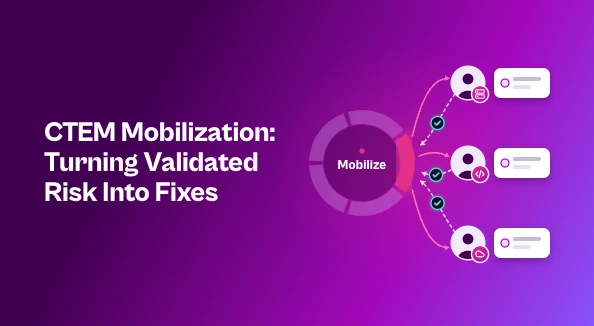
From there, Seemplicity handles mobilization. It routes exposures to the right owners, gives fixing teams response options ranging from full fixes to mitigations, and tracks every exposure through to closure.
Building a CTEM Technology Stack That Closes the Loop
The strongest CTEM technology stacks don’t come from adding categories. They come from connecting them. Start with where your program stalls today, whether that’s noisy prioritization, unproven risk, or fixes that never land. Then choose technology that carries each exposure from analysis to proof to resolution without losing context along the way.

Stay updated on Seemplicity blog
Subscribe today to stay informed and get regular updates from Seemplicity.