/does Qualys support a full CTEM program?
Qualys supports CTEM through Enterprise TruRisk Management (ETM), which provides asset discovery, TruRisk-based prioritization, and production-safe exploit validation. Gaps usually show up in mobilization: handling findings from non-Qualys tools, assigning the right owner, routing code-level fixes to developers, and cutting ticket volume through root-cause grouping. Seemplicity works alongside Qualys to turn prioritized exposures from your whole stack into fixes that get verified closed.
Qualys has been at the core of vulnerability management programs for a long time, and plenty of security teams still run VMDR as their primary scanner. As continuous threat exposure management has become the way security leaders frame their programs, Qualys has followed with a CTEM offering of its own.
For teams already running Qualys, the question is practical: can it carry a full CTEM program? Or does it get you very good at measuring risk while the actual fixing still happens somewhere else?
What Qualys Means by CTEM
Qualys’s CTEM play is Enterprise TruRisk Management (ETM). Qualys introduced ETM at its 2024 Qualys Security Conference, positioning it as a cloud-based Risk Operations Center (ROC) that brings together Qualys’s own security data and third-party risk data from partners such as Microsoft, Wiz and Okta, across cloud, on-premises and hybrid environments. qualys
The ROC idea is central. Instead of jumping between dashboards, teams get a single risk view scored with Qualys’s TruRisk model. Qualys describes ETM as discovering assets, aggregating and enriching risk signals, adding business context, and prioritizing threats with the TruRisk Score so teams can orchestrate and eliminate the risks that matter most. qualys
CTEM is a framework rather than something you install, so ETM is best understood as a platform that supports the program. How well the program works still depends on how each stage hands off to the next.
How Qualys Lines Up Against the Five CTEM Stages
Scoping and discovery. Qualys pairs its scanning heritage with CyberSecurity Asset Management (CSAM) and External Attack Surface Management (EASM). That gives teams a strong base for scoping and discovery, especially across infrastructure and endpoints.
Prioritization. Qualys says TruLens adds live threat context to exposures, and TruRisk combines that context with asset criticality and control signals to rank what matters. That’s a real step beyond CVSS-only prioritization. qualys
Validation. TruConfirm is designed to check whether a finding is actually exploitable in production using deterministic, production-safe validation. Built-in validation is a meaningful differentiator. qualys
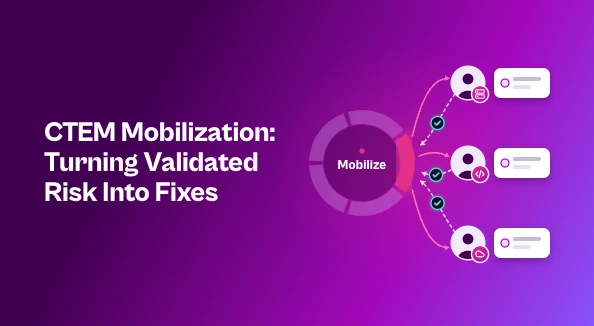
Mobilization. Qualys offers TruRisk Eliminate, Patch Management and ticketing integrations. It also positions Agent Val as a way to mitigate and revalidate exposures in a closed loop. qualys
On paper, Qualys covers every stage. In practice, the stages hold up best when the exposure lives on infrastructure Qualys already scans.
Where Qualys-Centric CTEM Gets Harder
Mixed stacks. Few organizations run Qualys alone. Findings come in from Wiz, Snyk, Tenable, bug bounty programs and cloud-native tools. ETM can ingest third-party data, but ingesting a finding is different from deduplicating, enriching and prioritizing it with the same depth as native Qualys data.
One scoring lens. Prioritization runs through TruRisk, which is Qualys’s model of what risk looks like. That’s useful, but some teams want prioritization logic they can shape to their own business context, independent of any single scanner vendor.
Code-level exposures. Application and dependency findings behave differently from host vulnerabilities. They belong to developers, they’re fixed in repositories, and one vulnerable library can surface across dozens of services.
Ownership and ticket volume. A ROC centralizes risk for the security team. It doesn’t automatically tell you which engineer owns a fix when asset tags are stale. And if every instance of an outdated base image becomes its own ticket, engineering stops paying attention fast.
Fixes that aren’t patches. Qualys is strong at patching and vulnerability mitigation on endpoints and servers. Many exposures, though, need a configuration change, a code change, or a decision from an application team, which means vulnerability remediation has to run through engineering workflows rather than a patch deployment.
How Seemplicity Fits In
Seemplicity is an agentic Exposure Action Platform built around what happens after an exposure is prioritized. It pulls in Qualys findings alongside every other tool in your stack, so no source is treated as second-class.
From there, AI Analysts confirm exploitability with evidence across hosts, code and dependencies. AI agents find the right owner, group related findings into root-cause fixes, write environment-specific fix guidance, and track each fix through Jira or ServiceNow until it’s verified closed.
Teams use Seemplicity alongside Qualys to close the gap between risk scoring and finished fixes, or as the unified layer for running exposure management across a multi-vendor environment.
Questions to Ask Before Running CTEM on Qualys
- How are findings from non-Qualys tools normalized, deduplicated and prioritized?
- Can we adjust prioritization logic to our own business context?
- Who owns a fix when asset data is incomplete or wrong?
- How many tickets would our current backlog become after grouping findings by root cause?
- How are code and dependency findings routed to developers?
- How is a fix tracked from detection to verified closure?
From TruRisk Scores to Closed Exposures
Qualys gives teams a strong foundation for discovery, scoring and validation, and for many organizations it’s a sensible anchor for Qualys CTEM. But a CTEM program only reduces risk when exposures actually close. That makes mobilization, especially across tools, teams and fix types, the part of the evaluation that deserves the most scrutiny.
See how Seemplicity turns prioritized exposures from Qualys and the rest of your stack into fixes your teams actually finish.

Stay updated on Seemplicity blog
Subscribe today to stay informed and get regular updates from Seemplicity.