
/what is vulnerability management?
Vulnerability management is the continuous process of finding, prioritizing, fixing and verifying security weaknesses across infrastructure, cloud and applications. It isn’t the same as vulnerability scanning, vulnerability assessment or patch management, which each cover only part of the process. Modern programs prioritize by real-world risk, such as active exploitation and business context, rather than severity scores alone. The discipline is now evolving into exposure management and CTEM, which add broader scope, validation and cross-team mobilization.
Vulnerability management is the continuous process of finding, prioritizing, fixing and verifying security weaknesses across an organization’s infrastructure, cloud environments and applications. Its goal is to reduce the weaknesses an attacker could use, starting with the ones that matter most.
The term often gets used as shorthand for scanning or patching. Both are part of it, but neither is the whole picture. Below, we cover what vulnerability management includes, how it works, what it’s commonly confused with, and how the discipline has evolved.
What Vulnerability Management Covers
A vulnerability is any weakness that could be exploited to compromise a system. In practice, vulnerability management deals with several kinds:
- Known software flaws, usually tracked as CVEs
- Misconfigurations in cloud services, servers and network devices
- Flaws in an organization’s own code
- Vulnerable open-source libraries and other third-party dependencies
These weaknesses sit across on-prem infrastructure, cloud accounts, containers, code repositories and internet-facing assets. New vulnerabilities are disclosed every day and environments change constantly, so vulnerability management is an ongoing program rather than a one-time project.
How Vulnerability Management Works
Most programs follow the same core cycle:
- Discover. Inventory assets and identify the weaknesses on them, mainly through scanning and security testing.
- Assess. Analyze each finding to understand what it affects and how serious it is.
- Prioritize. Rank findings by real-world risk, not by severity score alone.
- Remediate. Fix the weakness, or reduce its risk when a fix isn’t possible yet.
- Verify. Confirm the fix worked and the weakness is gone.
- Report. Track progress and show stakeholders how risk is changing.
Then the cycle repeats. For a closer look at each stage, see our guide to the vulnerability management lifecycle.
What Vulnerability Management Is Not
Several related terms get used interchangeably with vulnerability management. Each one covers only part of it.
It isn’t vulnerability scanning. Vulnerability scans identify weaknesses and produce findings. Vulnerability management decides what happens to those findings: which ones matter, who fixes them and by when. Scanning is an input, not the program.
It isn’t vulnerability assessment. An assessment is a point-in-time evaluation of an environment’s weaknesses. Vulnerability management is the continuous program that acts on what assessments find.
It isn’t patch management. Patching is one way to fix a vulnerability, and an important one. But many weaknesses are resolved through configuration changes, code fixes or library upgrades. Others can’t be patched right away and need vulnerability mitigation, such as network segmentation or a WAF rule, in the meantime. Some are formally accepted as low risk.
It isn’t only the security team’s job. Security teams usually find and prioritize vulnerabilities, but developers, IT and cloud teams do most of the fixing. A program works only when everyone knows what needs fixing, why it matters and who owns it.
How Vulnerability Management Has Evolved
Traditional vulnerability management ranked findings by severity, usually with CVSS scores. But severity describes how bad a flaw could be in theory, not how likely it is to be exploited in a specific environment. Ranking by CVSS alone leaves teams with long lists of “critical” findings and no clear way to choose between them.
Risk-based vulnerability management changed that. It adds exploitation data, such as the CISA Known Exploited Vulnerabilities catalog and EPSS scores, plus context like reachability, internet exposure and asset criticality. The result is vulnerability prioritization based on actual risk rather than theoretical severity.
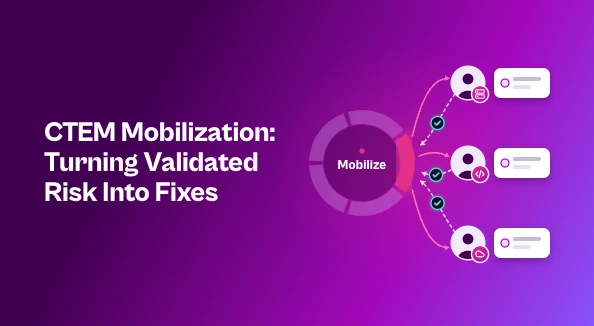
Exposure management takes the next step. It widens the scope beyond software vulnerabilities to every type of exposure across the attack surface, and adds validation of what’s truly exploitable. Gartner’s Continuous Threat Exposure Management (CTEM) framework structures this into five stages: scoping, discovery, prioritization, validation and mobilization. Mobilization, which means getting fixes done across teams, is where traditional programs most often fall short.
Why Vulnerability Management Matters
Attackers move quickly once a vulnerability is disclosed, and the time between disclosure and exploitation keeps shrinking. Vulnerability management is how organizations close known weaknesses before they’re used.
It’s also a baseline requirement in most security frameworks and regulations, including CIS Critical Security Control 7, PCI DSS and ISO 27001. And a well-run program gives security leaders a defensible answer to the question boards and auditors keep asking: are we getting less exposed over time?
How Seemplicity Fits In
Seemplicity is built for where vulnerability management is heading: exposure management and CTEM.
The Seemplicity Agentic Exposure Action Platform™ does everything a vulnerability management program sets out to do, then goes further:
- One view of exposure. Findings from infrastructure, cloud and code are consolidated, deduplicated and normalized in one place.
- Focus on real risk. Exposures are prioritized by exploitability and business context, so teams work on what attackers can actually use, not every CVE.
- Validated findings. Seemplicity’s AI Analysts check whether findings are exploitable in your environment.
- Fixes that get done. Work is routed to the right owners in the tools they already use, with response options when a patch isn’t possible yet, and tracked through to closure.
Vulnerability management tells you what’s wrong. Seemplicity makes sure it gets fixed.
Frequently Asked Questions
What is the difference between vulnerability management and vulnerability assessment?
A vulnerability assessment is a point-in-time evaluation that identifies and ranks weaknesses. Vulnerability management is the continuous program around it, covering prioritization, remediation, verification and reporting.
Is vulnerability management the same as patch management?
No. Patch management is one remediation method. Vulnerability management also covers configuration and code fixes, temporary mitigations, and formal risk acceptance.
What is risk-based vulnerability management?
Risk-based vulnerability management prioritizes findings by how likely they are to be exploited and how much damage they could cause. It uses signals like active exploitation, EPSS scores and asset criticality, rather than CVSS severity alone.
From Finding Vulnerabilities to Fixing Them
Vulnerability management isn’t defined by how many weaknesses a team can find. It’s defined by how reliably the ones that matter get fixed. Modern programs combine continuous discovery with risk-based prioritization, clear ownership and verified remediation, and they increasingly extend that approach to every exposure across the attack surface.
See how Seemplicity helps security teams turn findings into fixes. Book a demo.

Stay updated on Seemplicity blog
Subscribe today to stay informed and get regular updates from Seemplicity.