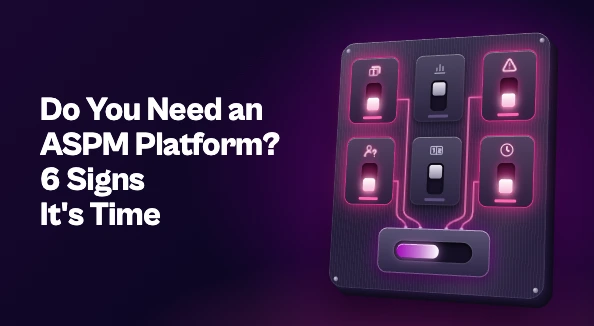
/When do you need an ASPM platform?
You likely need an ASPM platform when your AppSec scanners produce more findings than your team can manage by hand. Common signs include conflicting finding counts across tools, duplicate tickets for one issue, CVSS-only prioritization, unowned findings, triage falling behind release speed, and manual posture reporting. If three or more apply, it’s time. If you run only one or two scanners, or don’t yet know who owns your applications, start with that groundwork first.
Most AppSec teams didn’t set out to run five scanners. SAST came first, then SCA for open source, then container and IaC scanning, then DAST or API testing as the application estate grew. Each tool earned its place. Together, they produce more findings than any team can work through by hand.
That’s usually when an ASPM platform enters the conversation. By then, the question is rarely what ASPM is. It’s whether your team has reached the point where a platform pays off, or whether it would just become another dashboard.
Below are six signs it’s time, and a few signs it isn’t yet.
What an ASPM Platform Actually Does
An ASPM platform doesn’t scan anything. It sits above the scanners you already run and turns their output into one prioritized view of application risk.
Most ASPM tools follow the same basic flow. They ingest findings from SAST, SCA, DAST, IaC, secrets, and API testing tools. They deduplicate and correlate those findings, so one issue reported by three scanners becomes one item. Then they add context, such as reachability, internet exposure, and business criticality, and route each issue to the team that owns the fix.
Whether you need that layer depends less on the size of your company than on the problems your current setup is creating.
6 Signs It’s Time for an ASPM Platform
1. You Can’t Say How Many Open Findings You Have
Ask how many open application findings your team has, and the honest answer is “depends which tool you check.” The SAST console shows one number, the SCA dashboard another, the container scanner a third. If building a single, trustworthy count takes a spreadsheet and an afternoon, you don’t have a view of application risk. You have several partial ones.
2. One Issue Arrives as Several Tickets
A single vulnerable library can be flagged by your SCA tool, your container scanner, and your SAST tool, across dozens of repositories. If each instance becomes its own ticket, developers get flooded with what is really one piece of work. The usual result is that they start ignoring security tickets altogether.
3. Your Critical List Is Too Long to Act On
When vulnerability prioritization relies on CVSS scores alone, hundreds of findings end up labeled critical. Most of them pose little real risk, because the vulnerable code isn’t reachable, the service isn’t internet-facing, or there’s no evidence of exploitability. Without that context, teams either spread effort thinly or pick at random.
4. Findings Sit Without an Owner
If someone on the security team decides by hand where each finding goes, routing becomes the bottleneck. Findings land with whoever owned the repo two reorganizations ago, or wait in a shared queue no one is accountable for. Unowned work doesn’t get fixed, no matter how well it’s prioritized.
5. Code Is Shipping Faster Than You Can Triage It
AI coding assistants have sharply increased how much code teams ship, and every new release brings new findings. If triage is still a manual review of scanner output, the backlog will grow faster than people can sort it. At that point, adding headcount or another scanner only makes the backlog more thorough.
6. Reporting on Posture Is a Manual Project
Leadership wants to know whether application risk is going down. Auditors want proof that critical issues are fixed within SLA. If answering either means exporting from several tools and reconciling the results by hand, the reporting burden alone is a reason to consolidate.
One or two of these signs can often be handled with process changes. Three or more usually means the gaps sit between your tools, which is exactly where an ASPM platform works.
When an ASPM Platform Is Premature
An ASPM platform isn’t the right move for every team. It’s likely too early if any of these apply:
- You run one or two scanners on a small portfolio. With little overlap to correlate, the native consoles and a clear triage process may be enough for now.
- You don’t know which applications you have or who owns them. An ASPM platform will expose that gap, but it can’t fill it. A rough asset inventory of applications, repositories, and owning teams should come first.
- You expect it to replace your scanners. An ASPM platform needs findings to work with. With no scanners feeding it, there’s nothing to correlate or prioritize.
None of these rule ASPM out permanently. They just mean the groundwork comes before the platform.
Where Seemplicity Fits
Seemplicity is vendor-agnostic. It works with the AppSec scanners you already run, such as Checkmarx, Snyk, and Veracode, and addresses the signs above directly:
- One backlog, grouped by fix. Findings from every scanner are deduplicated and correlated, and when one upgrade closes dozens of findings, it becomes a single remediation task.
- Reachability confirmed before work reaches developers. Seemplicity’s AI Analysts, including the Code Analyst and SCA Analyst, check whether vulnerable code and dependencies are actually reachable.
- Ownership-based routing. Findings are mapped to the teams and code owners responsible for them, and bi-directional Jira and ServiceNow integrations keep status and SLAs in sync.
- One program, not another silo. Application findings sit alongside cloud and infrastructure exposures, so AppSec becomes part of a broader exposure management effort rather than a separate stream of tickets.
Count the Signs, Then Decide
If three or more of these signs describe your team, the cost of not consolidating is already showing up in slower fixes and developers who tune out security tickets. An ASPM platform won’t fix ownership or process gaps on its own, but it removes the friction between your tools that keeps those gaps in place.
If you’re ready to move forward, our rollout plan for application security posture management tools walks through what to do first. To see how Seemplicity turns AppSec findings into shipped fixes, book a demo.

Stay updated on Seemplicity blog
Subscribe today to stay informed and get regular updates from Seemplicity.