

Attack Surface Management Use Cases: 6 Ways Security Teams Put ASM to Work

/What are the main use cases for attack surface management?
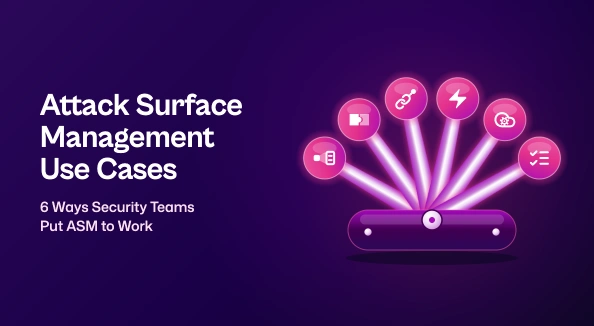
Attack surface management (ASM) is most valuable in six common scenarios: uncovering shadow IT and unmanaged assets, assessing risk during mergers and acquisitions, monitoring third-party and supply chain exposure, responding quickly to newly disclosed vulnerabilities, catching cloud misconfigurations and drift, and supporting compliance and audit readiness. In each case, ASM provides the visibility, but risk only goes down when findings are prioritized, assigned to the right owner, and fixed.
Most explanations of attack surface management stay abstract: discover assets, monitor exposures, reduce risk. That’s accurate, but it doesn’t show where ASM earns its budget. In practice, its value shows up in specific situations, like a new acquisition, an unexpected critical CVE, or an audit that asks what you had exposed last quarter.
Below are six of the most common attack surface management use cases, what ASM contributes to each, and the step that decides whether any of it reduces risk.
What Attack Surface Management Does
Attack surface management (ASM) is the continuous discovery, inventory, and monitoring of every asset an attacker could reach, including the ones security doesn’t know about. It assumes your official asset inventory is incomplete and works to close that gap.
It generally comes in two forms. External attack surface management (EASM) maps your internet-facing footprint from the outside in, the way an attacker would. CAASM (cyber asset attack surface management) works from the inside out, pulling data from EDR, cloud, identity, and CMDB tools to build a reconciled view of every asset.
1. Uncovering Shadow IT and Unmanaged Assets
This is the use case ASM was built for. A developer spins up a test environment and forgets it. Marketing launches a campaign site on a new domain. A team signs up for a SaaS tool without involving IT. None of these make it into the CMDB, so none of them get scanned, patched, or monitored.
ASM finds them by looking at what’s actually connected to your organization, through DNS records, certificates, IP ranges, and cloud accounts, rather than what’s on the list. The catch is that an asset nobody registered usually has no owner attached, which matters the moment something on it needs fixing.
2. Assessing Risk During Mergers and Acquisitions
An acquisition brings in infrastructure nobody on your team has mapped: domains, cloud accounts, legacy applications, and sometimes entire networks. Before close, ASM gives you an outside-in view of the target’s exposure as part of due diligence, without needing internal access. After close, it helps you bring those assets into scope systematically instead of discovering them one incident at a time.
The same logic applies to subsidiaries and regional business units that run their own IT. If they operate under your brand, their exposures are effectively yours.
3. Monitoring Third-Party and Supply Chain Exposure
Your attack surface doesn’t stop at assets you operate. Vendor-hosted services, integrations, and connected applications all create paths into your environment. ASM can surface exposed assets associated with your organization that a third party runs on your behalf, along with lookalike or abandoned assets tied to your brand.
That gives third-party risk reviews something more concrete than a vendor questionnaire: observed evidence of what’s actually exposed.
4. Responding Fast to Newly Disclosed Vulnerabilities
When a critical vulnerability is disclosed, the first question from leadership is always the same: are we exposed, and where? Answering it depends on knowing which assets run the affected software, including the ones outside normal management.
With a current attack surface inventory, that answer takes minutes instead of days of manual searching. Speed matters more than ever here. If a CVE lands on a list of known exploited vulnerabilities, the window between disclosure and active exploitation can be very short, and every exposed instance you miss is one an attacker might find first.
5. Catching Cloud Misconfigurations and Drift
Cloud resources are created and changed constantly, often mid-sprint and outside formal review. A storage bucket made public for testing, a security group opened “temporarily,” or a new workload deployed with default settings can all create exposure between scheduled assessments.
This is where cloud attack surface management earns its place. Continuous monitoring catches these changes as they happen, which is especially valuable during cloud migrations, when environments change fastest and ownership is often least clear.
6. Supporting Compliance and Audit Readiness
Many security frameworks and regulations expect organizations to maintain an accurate, ongoing view of their assets, not a point-in-time snapshot. ASM provides that continuously, along with a record of what existed, when it appeared, and how it was handled.
It also surfaces coverage gaps, such as assets missing endpoint agents or excluded from vulnerability scanning, so you can address them before an auditor points them out.
Where Every Use Case Hits the Same Wall
Look closely at each scenario above and they all end the same way: with a set of findings that someone needs to prioritize, assign, and fix. ASM is very good at producing that list. It doesn’t, on its own, make the list shorter.
A few things consistently get in the way. ASM findings land alongside results from vulnerability scanners, cloud security tools, and AppSec tools, each with its own format and severity scale, so the same issue can show up several times with different scores. Without consolidated prioritization, teams either chase noise or miss what matters. And because many ASM discoveries are assets nobody claimed, findings often stall before remediation even begins, bouncing between teams or sitting in a spreadsheet.
How Seemplicity Fits In
Seemplicity isn’t an ASM tool. It works alongside your attack surface management tools and picks up where discovery leaves off.
The Seemplicity Agentic Exposure Action Platform brings ASM findings together with the rest of your security stack, deduplicates them, and prioritizes them in one place using business and threat context. Find the Fixer works out ownership, including for assets that arrive without reliable owner tags. From there, fixes route into the tools teams already use, such as Jira and ServiceNow, and are tracked through to closure, turning discovery into vulnerability remediation rather than another backlog.
Making Attack Surface Management Pay Off
Attack surface management proves its value in specific moments: an acquisition, a zero-day, a cloud migration, an audit. In each of them, the visibility ASM provides is the starting point, not the outcome.
The programs that get the most from ASM connect what they discover to clear ownership and a repeatable path to remediation. That’s how a growing list of exposures becomes a shrinking one.
See how Seemplicity turns attack surface findings into fixes.
Stay updated on Seemplicity blog
Subscribe today to stay informed and get regular updates from Seemplicity.