/What is cloud attack surface management and how does it work?
Cloud attack surface management is the continuous process of discovering every cloud asset you own, assessing it for misconfigurations, vulnerabilities and excessive permissions, prioritizing exposures by real risk, and getting them fixed. It combines inside-out visibility from tools like CSPM and CNAPP with outside-in visibility from EASM. It runs as an ongoing cycle of discovery, assessment, prioritization, remediation and monitoring.
Every deployment changes your cloud footprint. A developer spins up a test environment, a team opens a storage bucket to share data with a partner, a service account picks up broader permissions than it needs. Each change can create a new way in, and most happen without security in the loop. Cloud attack surface management is how security teams keep up with that change.
Every deployment changes your cloud footprint. A developer spins up a test environment, a team opens a storage bucket to share data with a partner, a service account picks up broader permissions than it needs. Each change can create a new way in, and most happen without security in the loop.
Cloud attack surface management is how security teams keep up with that change. This guide covers what it is, what it includes, how it works, and how it relates to CSPM, CNAPP and EASM.
What Is Cloud Attack Surface Management?
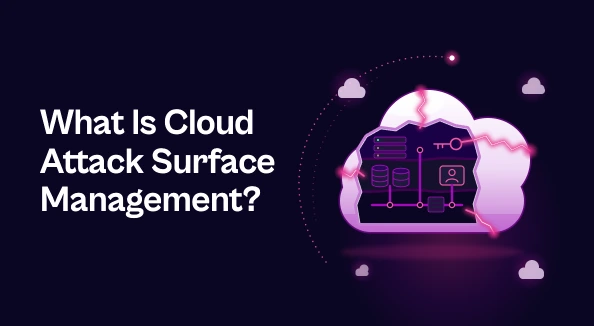
Cloud attack surface management is the continuous process of discovering, assessing, prioritizing and fixing exposures across your cloud environments. It answers three questions: what cloud assets do we have, which of them are exposed or at risk, and what needs to be fixed first.
It covers more than internet-facing assets. Overly permissive identities, misconfigured services and forgotten resources inside your cloud accounts are part of the attack surface too, because an attacker who gets a foothold will use them.
It’s also an ongoing practice, not a one-time audit. Cloud environments change by the hour, so a point-in-time inventory goes stale almost as soon as it’s finished. In that sense, cloud attack surface management is one part of broader exposure management, which applies the same discover, prioritize and fix loop across the whole environment.
What Makes Up the Cloud Attack Surface
Your cloud attack surface is every resource, identity and connection an attacker could use to get in or move around. It typically includes:
- Compute: virtual machines, containers, Kubernetes clusters and serverless functions.
- Storage and data: object storage buckets, databases, file shares and snapshots.
- Identities and access: user accounts, roles, service accounts, access keys and the permissions attached to them.
- Network exposure: public IP addresses, open ports, security groups, load balancers and gateways.
- APIs and interfaces: public APIs, management consoles and admin panels.
- DNS and domains: subdomains and DNS records pointing at cloud resources, including ones whose resources no longer exist.
- Managed services and integrations: managed cloud services and third-party SaaS connections, each with their own settings.
In multi-cloud environments, that list repeats across AWS, Azure and Google Cloud, each with its own defaults and terminology.
Why the Cloud Attack Surface Is Hard to Manage
On-prem attack surfaces changed slowly. Cloud attack surfaces change with every commit. A few things make them harder to keep track of:
- Anyone can create infrastructure. With infrastructure as code and self-service accounts, developers deploy resources directly, and security often finds out after the fact.
- Identity has replaced the perimeter. A stale access key or over-privileged role can be as useful to an attacker as an open port, and it’s much harder to spot.
- Resources are short-lived. Containers and serverless functions can appear and disappear between scans, so periodic assessments miss them.
- Old resources linger. Test environments, orphaned snapshots and unused public IPs stay exposed long after anyone remembers creating them.
- Every cloud works differently. Multi-cloud means separate security models, defaults and native tools to reconcile.
The result is an attack surface that grows faster than any team can review by hand, which is why automation and continuous monitoring sit at the center of the practice.
How Cloud Attack Surface Management Works
The process runs as a continuous cycle rather than a project with an end date. Most programs follow five stages:
- Discovery. Build and maintain an asset inventory covering every cloud account and subscription. This combines an inside-out view, from tools connected to your cloud accounts through APIs, with an outside-in view that scans the internet for assets tied to your organization. Each catches what the other misses.
- Assessment. Check each asset for misconfigurations, vulnerabilities, excessive permissions and unintended exposure. Attach context such as owner, environment and business function.
- Prioritization. Rank exposures by real risk, not severity scores alone. A medium-severity misconfiguration on an internet-facing database often matters more than a critical finding on an isolated test instance.
- Remediation. Route each fix to the team that owns the resource, in the tools they already use, with enough context to act. If the resource is defined in infrastructure as code, the fix belongs in the code, or the issue comes back on the next deploy.
- Monitoring and validation. Watch for new assets and changes, confirm that fixes held, and start the cycle again.
Cloud Attack Surface Management vs. CSPM, CNAPP and EASM
These terms often get used interchangeably, but they cover different ground. The difference comes down to scope and vantage point.
| Approach | What it does | Where it stops |
|---|---|---|
| Cloud security posture management (CSPM) | Continuously checks resources in connected cloud accounts against security baselines. | Only sees accounts it’s connected to, and focuses on configuration. |
| Cloud-native application protection platform (CNAPP) | Bundles posture, workload protection, identity entitlements and often code scanning. | Still an inside-out view of known accounts. |
| External attack surface management (EASM) | Scans the internet for exposed assets, including ones nobody knew about. | Lacks internal context such as permissions, owners and what sits behind the asset. |
Cloud attack surface management doesn’t replace any of these. It’s the practice of bringing their views together, inside-out and outside-in, so you have a complete picture of what’s exposed and can act on it. Most teams already run a mix of attack surface management tools, cloud security tools and scanners. The harder part is turning everything they find into coordinated fixes.
How Seemplicity Fits In
Seemplicity doesn’t discover cloud assets or scan cloud accounts. Your ASM, CSPM and CNAPP tools already do that. Seemplicity handles what comes next.
The Seemplicity Agentic Exposure Action Platform™ pulls findings from your cloud security and attack surface tools into one view. It removes duplicates, correlates findings on the same asset, and prioritizes them using exposure and business context. It then identifies the right owner for each fix, routes the work into the tools engineering teams already use, and tracks it through to closure.
That way, what your tools find turns into fixes instead of a growing backlog.
Keeping Pace With a Cloud That Never Stops Changing
Cloud attack surface management starts with knowing what you have, but it only pays off when exposures actually get fixed. The strongest programs combine inside-out and outside-in visibility, prioritize by real-world risk, and treat ownership and remediation as part of the process rather than an afterthought.
Because the cloud keeps changing, the work never really finishes. Running it as a continuous cycle, and as part of a broader CTEM program, is what keeps the attack surface under control as it grows.

Stay updated on Seemplicity blog
Subscribe today to stay informed and get regular updates from Seemplicity.