
/What CTEM tools do I need?
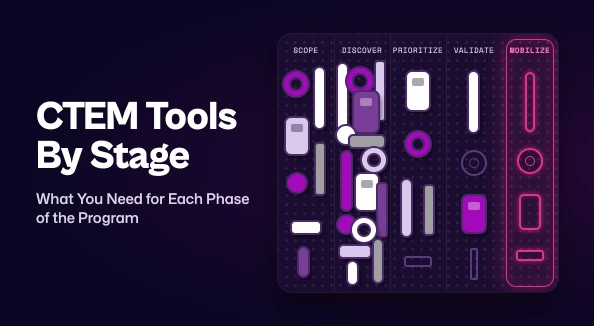
There’s no single CTEM tool. CTEM is a five-stage program, and each stage relies on different capabilities: asset inventory and EASM for scoping, scanners and cloud and AppSec tools for discovery, risk-based prioritization and threat intelligence for prioritization, BAS and pen testing for validation, and ownership mapping, ticketing, and SLA tracking for mobilization. Most organizations are well covered on discovery but weak on prioritization and mobilization, which is where exposures stall. The best approach is to map your existing tools to each stage, find the gaps, and invest in the layer that connects findings to fixes.
Continuous threat exposure management is a program made up of five stages (scoping, discovery, prioritization, validation, and mobilization), and each stage relies on different capabilities. When people search for CTEM tools, what they really need is a clear picture of which tools support which stage, and where their current stack falls short.
This guide maps common tool categories to each stage so you can see what you already have and what’s missing.
Scoping: Tools That Define What Matters
Scoping sets the boundaries of the program: which parts of the business you’re protecting and which assets matter most. Without it, every later stage runs on guesswork.
- Asset inventory and CAASM tools pull asset data from across your environment into a single asset inventory, giving you a baseline of what exists.
- External attack surface management (EASM) finds internet-facing and unknown assets that internal inventories miss.
- Business context sources such as your CMDB, asset criticality ratings, and ownership records tell you which assets support critical business functions.
Good CTEM scoping depends less on any one tool than on connecting these sources so scope reflects business priorities rather than raw asset counts. For more detail, see our guide to CTEM scoping.
Discovery: Tools That Find Exposures
Discovery identifies the vulnerabilities, misconfigurations, and weaknesses across the assets in scope. This is where most organizations are already well equipped.
- Vulnerability scanners for infrastructure, endpoints, and networks
- Cloud security tools (CSPM, CNAPP) for misconfigurations and cloud-specific risk
- Application security testing (SAST, DAST, SCA) for code and dependency issues
- Identity and SaaS posture tools for excessive permissions and risky configurations
The challenge in CTEM discovery is rarely a lack of findings. It’s the opposite: multiple tools reporting overlapping issues in different formats, which buries the exposures that matter. Read more about CTEM discovery.
Prioritization: Tools That Decide What to Fix First
Prioritization narrows thousands of findings down to the exposures that pose real risk to your organization. Severity scores alone can’t do this.
- Risk-based prioritization tools that go beyond CVSS
- Threat intelligence inputs such as known exploited vulnerabilities (KEV) and exploit prediction (EPSS)
- Business context that weights exposures by asset criticality, reachability, and potential impact
Effective CTEM prioritization combines all three. A critical CVE on an isolated test server shouldn’t outrank a medium-severity issue on an internet-facing system that handles customer data. See our breakdown of CTEM prioritization.
Validation: Tools That Confirm Real Risk
Validation tests whether prioritized exposures are actually exploitable in your environment, and whether existing controls would stop an attack.
- Breach and attack simulation (BAS) runs automated attack scenarios against your controls
- Automated penetration testing probes for exploitable paths at scale
- Red teaming tests defenses with human-led, goal-driven attacks
CTEM validation helps teams avoid spending remediation effort on exposures that compensating controls already neutralize. Learn more about CTEM validation.
Mobilization: Tools That Get Exposures Fixed
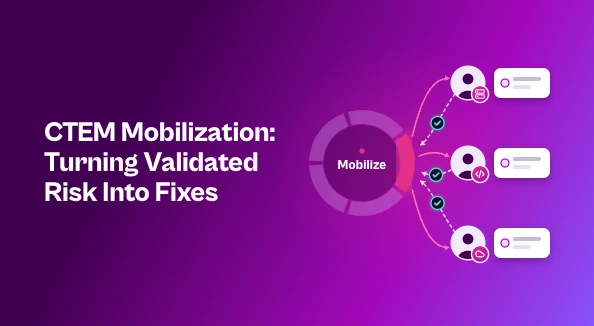
Mobilization turns validated, prioritized exposures into completed fixes. It requires coordination between security and the teams that own the affected assets, which makes it the stage where most programs stall.
- Ownership mapping to route each exposure to the right team
- Ticketing and workflow integrations with tools like Jira and ServiceNow
- SLA tracking and reporting to measure progress and hold teams accountable
Most security stacks are heavy on detection and light on actually turning findings into fixes. Findings pile up because there’s no clear path from “this matters” to “someone is fixing it.”
Common Gaps When Assembling a CTEM Tool Stack
Even organizations with strong tooling in every category often run into the same problems:
- Siloed data. Each scanner uses its own format and scoring, so the same issue appears multiple times with different severity ratings. Without normalization, prioritization is unreliable.
- Disconnected stages. Prioritization outputs don’t feed directly into remediation workflows, so context gets lost in handoffs.
- Tool sprawl without a unifying layer. Adding more tools increases findings without increasing fixes.
These gaps are why CTEM programs often fail at the later stages, even when discovery coverage is excellent.
How Seemplicity Fits In
Seemplicity doesn’t replace your scanners or testing tools. It works as the connective layer across them, focused on the stages where programs typically break down:
- Aggregates and deduplicates findings from your existing security tools into one normalized view
- Prioritizes exposures using threat intelligence and business context
- Maps ownership and automates remediation workflows, routing fixes to the right teams through the tools they already use
- Tracks progress and SLAs so security can measure whether exposure is actually going down
The result is a CTEM program that moves exposures from discovery all the way through to remediation, without adding another silo.
Start With the Stages, Not the Shortlist
Choosing CTEM tools works best when you start from the program rather than a vendor list. Map what you already have to each of the five stages, identify where findings stall, and focus investment there. For most teams, that means fewer new detection tools and more capability in prioritization and mobilization.

Stay updated on Seemplicity blog
Subscribe today to stay informed and get regular updates from Seemplicity.