
/What does Gartner say about CTEM?
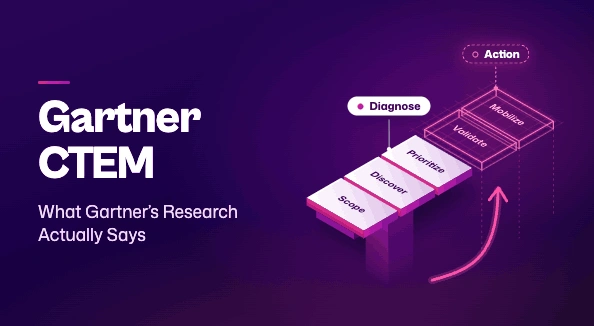
Gartner introduced continuous threat exposure management (CTEM) in 2022 as a continuous program, not a single product. It runs in five stages: scoping, discovery, prioritization, validation and mobilization. Gartner groups these into two halves: diagnose, which covers finding and ranking exposures, and action, which covers confirming and fixing them. It predicted that organizations prioritizing security investment through CTEM would see a two-thirds reduction in breaches by 2026. It has also defined supporting categories like Exposure Assessment Platforms and Adversarial Exposure Validation, and positioned CTEM as the next step for existing vulnerability management programs. Gartner’s latest research puts more weight on the action half, where most programs stall.
Gartner coined continuous threat exposure management (CTEM) in 2022, and its framework is still the reference point for most exposure management programs. Most coverage, though, repeats the five stages and stops there. Gartner has published more than that: a way to group the stages, a widely quoted prediction, new technology categories, and guidance on moving from vulnerability management to exposure management.
This post covers what Gartner’s CTEM research says and why each piece matters for security teams.
Where Gartner’s CTEM Framework Came From
Gartner introduced CTEM to address a familiar problem. Security teams were scanning more, finding more and fixing about the same, so vulnerability backlogs kept growing without any clear drop in risk.
Gartner’s answer was to stop treating exposure as a list of findings and start treating it as a continuous program tied to business priorities. The idea caught on quickly. By 2023, Gartner had identified CTEM as one of its top cybersecurity trends.
From the start, Gartner has framed CTEM as a program rather than a single product. Tools support each stage, but the program is the cycle itself.
Gartner’s Two Halves of CTEM: Diagnose and Action
Gartner’s five stages are scoping, discovery, prioritization, validation and mobilization. Gartner also sorts them into two groups, which explains a lot about why some programs succeed and others stall. Gartner defines CTEM around two pivotal pillars: diagnose and action.
- Diagnose covers scoping, discovery and prioritization. These stages work out what’s exposed and what matters most.
- Action covers validation and mobilization. These stages confirm what’s actually exploitable and get the right teams to fix it.
Most security programs are much stronger at diagnosing than at acting. Discovery tools are mature and prioritization has improved, but mobilization still often runs on spreadsheets, email threads and tickets that nobody owns. The split makes it clear that a CTEM program is only as effective as its action half.
Related Gartner Categories: EAP and AEV
As CTEM matured, Gartner defined technology categories to support it. In 2024, Gartner delineated related technology categories, such as Exposure Assessment Platforms (EAP) and Adversarial Exposure Validation (AEV), to support CTEM programs.
- Exposure assessment platforms consolidate exposure data and help teams prioritize it, which maps mainly to discovery and prioritization.
- Adversarial exposure validation tests whether exposures can actually be exploited, which maps to the validation stage.
Neither category covers the whole cycle. That’s why teams often struggle when they assemble a CTEM program from separate point tools. Each one handles a single stage, and the handoffs between them, especially into mobilization, are where work gets lost.
Gartner on Growing Vulnerability Management Into Exposure Management
Gartner doesn’t expect organizations to build CTEM from scratch. Its November 2024 report, How to Grow Vulnerability Management Into Exposure Management, treats CTEM as the natural next stage for existing vulnerability management programs.
The report treats visibility as the starting point: one of the early steps in maturing a vulnerability management program into an exposure management program is to obtain optimal visibility across the attack surfaces your digital infrastructure occupies. From there, programs expand beyond CVEs to cover misconfigurations, identities and other exposure types. They also tie prioritization to business context instead of severity scores alone.
For most teams, this is the realistic route to exposure management: extending the program they already run rather than starting over.
Where Gartner’s CTEM Thinking Is Heading
Gartner’s recent research has added urgency. AI models are speeding up vulnerability discovery for defenders and attackers alike, and Gartner analysts wrote in May 2026 that Anthropic’s Claude Mythos Preview and Project Glasswing “require” effective CTEM.
The direction is consistent across this newer research. Visibility and prioritization are no longer enough on their own. As the time between disclosure and exploitation shrinks, Gartner’s emphasis is moving toward faster, more automated action, which again puts the focus on mobilization.
How Seemplicity Fits Gartner’s CTEM Model
Seemplicity supports the full CTEM cycle, with particular depth in the action half, where programs most often stall:
- Scoping: Maps findings to business context, such as asset criticality, ownership and business units, so each cycle focuses on what matters to the organization.
- Discovery: Aggregates, normalizes and deduplicates findings from your existing security tools into a single view.
- Prioritization: Ranks exposures using exploitability, threat intelligence and business context.
- Validation: Brings in results from validation and testing tools and accounts for compensating controls, so teams can separate real, exploitable risk from theoretical findings.
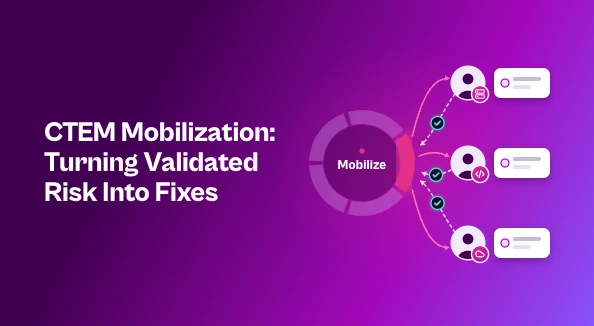
- Mobilization: Automates ownership assignment, ticketing, SLAs and tracking to closure, bringing exposure management into the workflows your teams already use.
Turning Gartner’s CTEM Guidance Into Results
Gartner’s CTEM research gives security teams a clear model: diagnose exposure continuously, then act on it. The diagnose half is well served by existing tools. The results Gartner points to, including fewer breaches and measurable risk reduction, depend on the action half. Programs that treat mobilization as seriously as discovery are the ones that turn Gartner’s framework into fewer open exposures.

Stay updated on Seemplicity blog
Subscribe today to stay informed and get regular updates from Seemplicity.