
/what is the meaning of php?
PHP stands for “PHP: Hypertext Preprocessor,” a recursive acronym that originally meant “Personal Home Page.” It’s a server-side scripting language that runs on web servers and generates the pages browsers display, powering platforms like WordPress, Drupal and Laravel. PHP is in the security news because of PHP2Shell and other critical 2026 flaws in PHP itself, which affect every app running on a vulnerable version until it’s patched.
PHP stands for PHP: Hypertext Preprocessor. It’s a recursive acronym, meaning the first word of the name is the name itself.
It didn’t start that way. Rasmus Lerdorf created PHP in 1994 as a small set of tools for tracking visits to his online résumé, and called it Personal Home Page Tools. As the project grew into a full programming language, the name was changed in 1998 with PHP 3 to the recursive version used today, keeping the same three letters.
What PHP Is and What It Does
PHP is a server-side scripting language. Its code runs on the web server, not in the visitor’s browser, and its job is to build the page the browser receives.
Here’s what happens when someone visits a PHP-powered page:
- The browser sends a request to the web server, such as Apache or nginx.
- The web server hands the request to PHP, usually through PHP-FPM or Apache’s mod_php.
- PHP runs the page’s code. It might query a database, check a login session or pull in a template.
- PHP returns finished HTML to the web server, which sends it to the browser.
The visitor never sees the PHP code, only its output. A line like <?php echo “Hello, ” . $name; ?> turns into plain text such as “Hello, Sam” before it leaves the server.
Because PHP sits between the internet and your application’s data, it handles a lot of sensitive work: sessions, logins, file uploads and form input. That’s also why a flaw in PHP itself is so serious.
Where PHP Is Used
PHP powers an estimated 70% of websites whose server-side language is known. You’ve almost certainly used it today without realizing it.
- Content management systems. WordPress, Drupal and Joomla are all written in PHP. WordPress alone runs a large share of the web.
- Ecommerce. Platforms such as Magento (Adobe Commerce) and WooCommerce run on PHP.
- Frameworks and custom apps. Laravel and Symfony are popular PHP frameworks for building web applications and APIs.
- Internal tools. Admin panels, intranets, wikis and dashboards are often PHP under the hood.
- Network appliances. Many firewalls, VPN gateways and device management consoles use PHP for their web interfaces.
That last category is easy to overlook. A company might not think of itself as a “PHP shop” yet still have PHP on its attack surface through a vendor appliance or a forgotten marketing site.
Why PHP Is in the Security News Right Now
If you’ve seen PHP in the headlines lately, it’s because of a run of critical flaws in PHP itself.
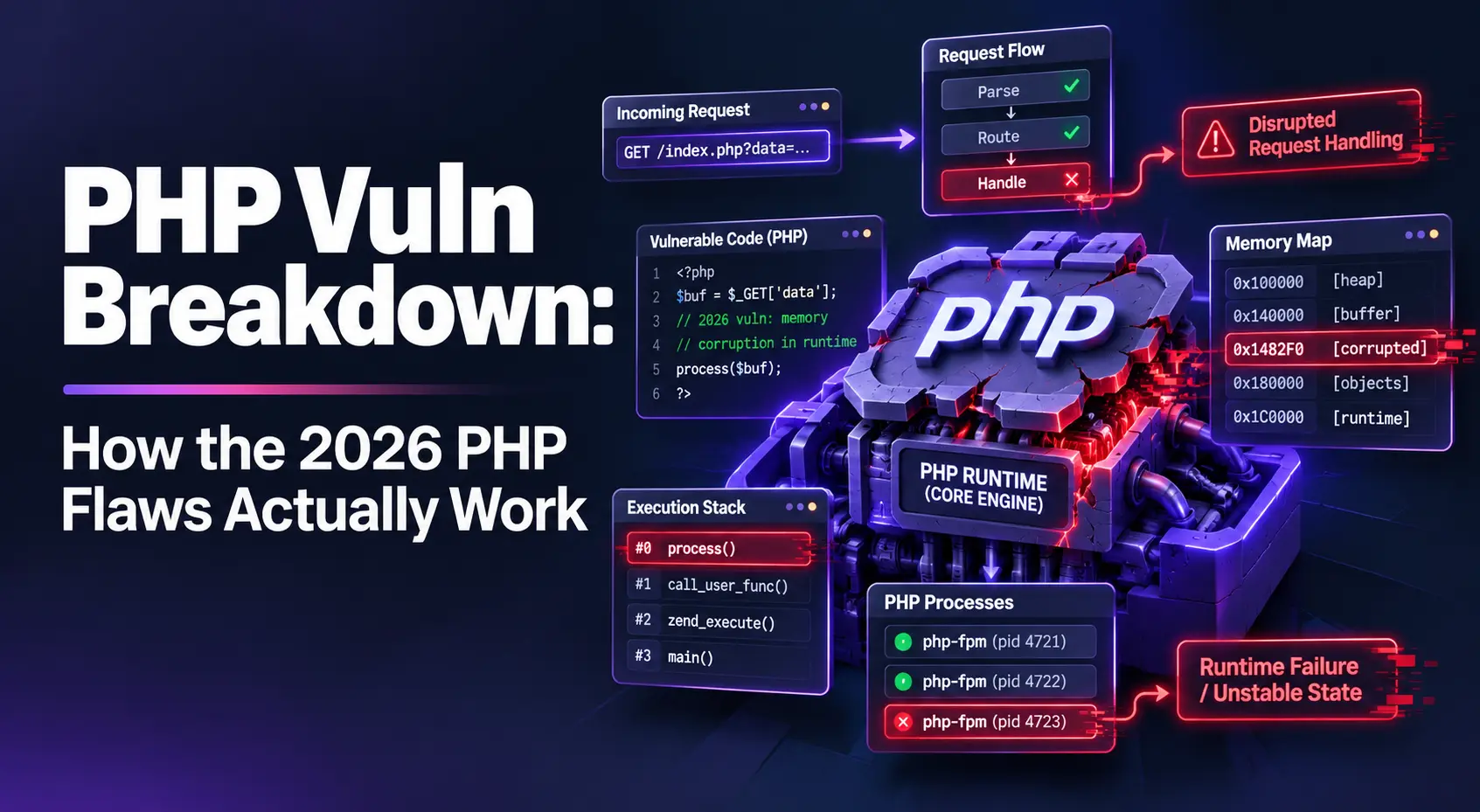
- PHP2Shell (October 2026). Two critical flaws, CVE-2026-109618 and CVE-2026-109619, allow unauthenticated remote code execution on PHP servers. Attackers began exploiting them before the patch was released, and CISA has added them to its list of known exploited vulnerabilities.
- The November 19 release. PHP fixed 18 more vulnerabilities, seven of them critical, in session handling, PHP-FPM and core memory management.
What makes this different from most software vulnerabilities is where the flaws sit. A bug in a WordPress plugin affects sites running that plugin. A bug in PHP affects every application running on the vulnerable version, whether that’s a blog, an online store or a firewall’s admin panel.
The fix is straightforward: update to PHP 8.5.13, 8.4.28, 8.3.37 or 8.2.36 (or 8.6.0), then restart PHP so the patched code actually loads. For the full details, see our guide to the current PHP vulnerability.
PHP in One Sentence
PHP (PHP: Hypertext Preprocessor) is the server-side language behind most of the web, which makes keeping it patched one of the most far-reaching security tasks a team has.
If you run PHP anywhere, the practical takeaway is simple. Know which versions you have, apply the latest PHP patch when it ships, and check each new PHP CVE against your setup. The language is three decades old, but as 2026 has shown, its security still needs constant attention.

Stay updated on Seemplicity blog
Subscribe today to stay informed and get regular updates from Seemplicity.